Stacked imbalances
How footprint imbalances are measured diagonally, the imbalance ratio, stacked runs of imbalanced levels, and hiding dust rows.
An imbalance is a price where one side traded far more than the other. On a footprint it colours the cell (with
Colour by on Imbalance),
counts toward the Imb read-out, and — when several line up — draws a stacked-imbalance mark. The settings are
in Settings (⚙) with the footprint panel selected.
Measured diagonally
A buyer lifting the ask and a seller hitting the bid at the same price are two separate events, so comparing the two halves of one row says little. TapeHawk compares them the way the orders actually meet:
- Buying at a price against selling one level below it — an ask cell is imbalanced when its volume outweighs the bid cell diagonally below;
- Selling at a price against buying one level above it — a bid cell is imbalanced when its volume outweighs the ask cell diagonally above.
Two edge rules keep the reading honest:
- If the opposite cell is empty but still inside the bar's traded range, that side traded nothing there — the strongest imbalance there is, and it is coloured as such.
- The bid cell of a bar's top row and the ask cell of its bottom row have no diagonal neighbour inside the bar, so they are never marked.
Rows that carry only a sliver of the bar's volume are coloured more faintly, so a tiny trade against nothing does not look like the loudest row on the chart.
Imbalance ratio
How many times larger one side must be to count as imbalanced — 3× by default. Lower it to mark more levels, raise it to keep only the one-sided ones. Colour starts at this ratio and keeps strengthening above it, so a level far past the ratio is visibly more saturated than one that just clears it.
The count of imbalanced rows in the info bar (Imb) and in the data window uses the same ratio.
Stacked imbalance
Marks a run of consecutive price levels all imbalanced the same way with a solid bar down the outer edge of the column — on the left for a run of bid imbalances, on the right for ask imbalances. Choose how many levels in a row make a run (3 by default), or Off.
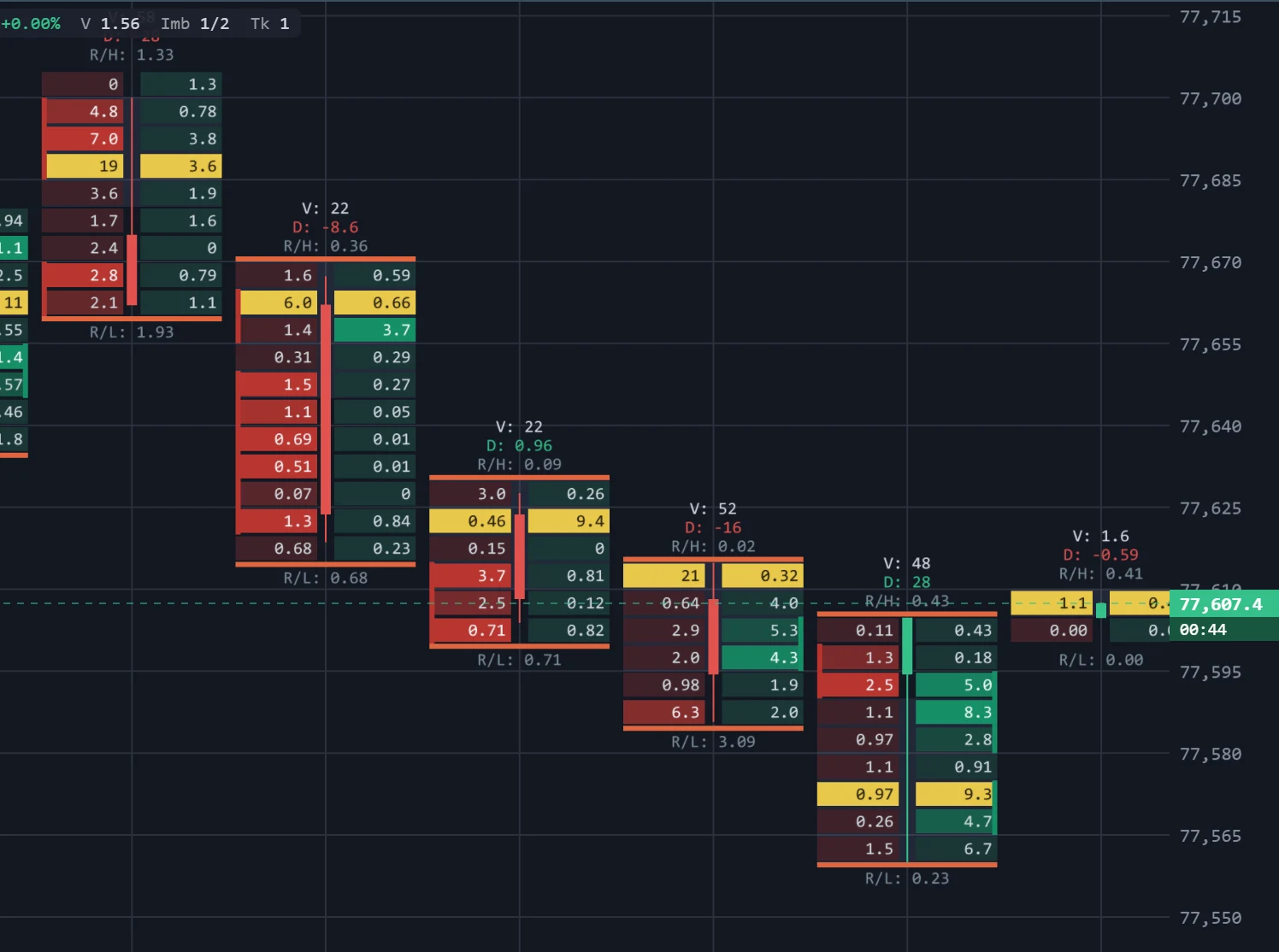
A stack of buying imbalances means buyers kept overwhelming sellers level after level; a stack of selling imbalances, the reverse. The run must be unbroken — a hidden row ends it.
Hide dust rows
Hides rows whose volume is less than this percentage of the bar's POC volume. At 0%, the default, every row is shown. Raising it tidies up the thin tails of each bar.
Hiding rows changes what the imbalance rules see. A cell whose diagonal neighbour is hidden is compared against
nothing, so it counts as the strongest imbalance — raising this setting can add imbalance colour, Imb
counts and stacked runs beside the rows it hides. A hidden row still breaks a stacked run. The value area, volume
nodes and unfinished-auction marks are also worked out from the rows still shown; the POC, V: and D: are
not.