Macro
Nineteen free macro series from FRED, the World Bank and the IMF — what each column means, how to read a series' history, the forecast and late tags, and the release calendar.
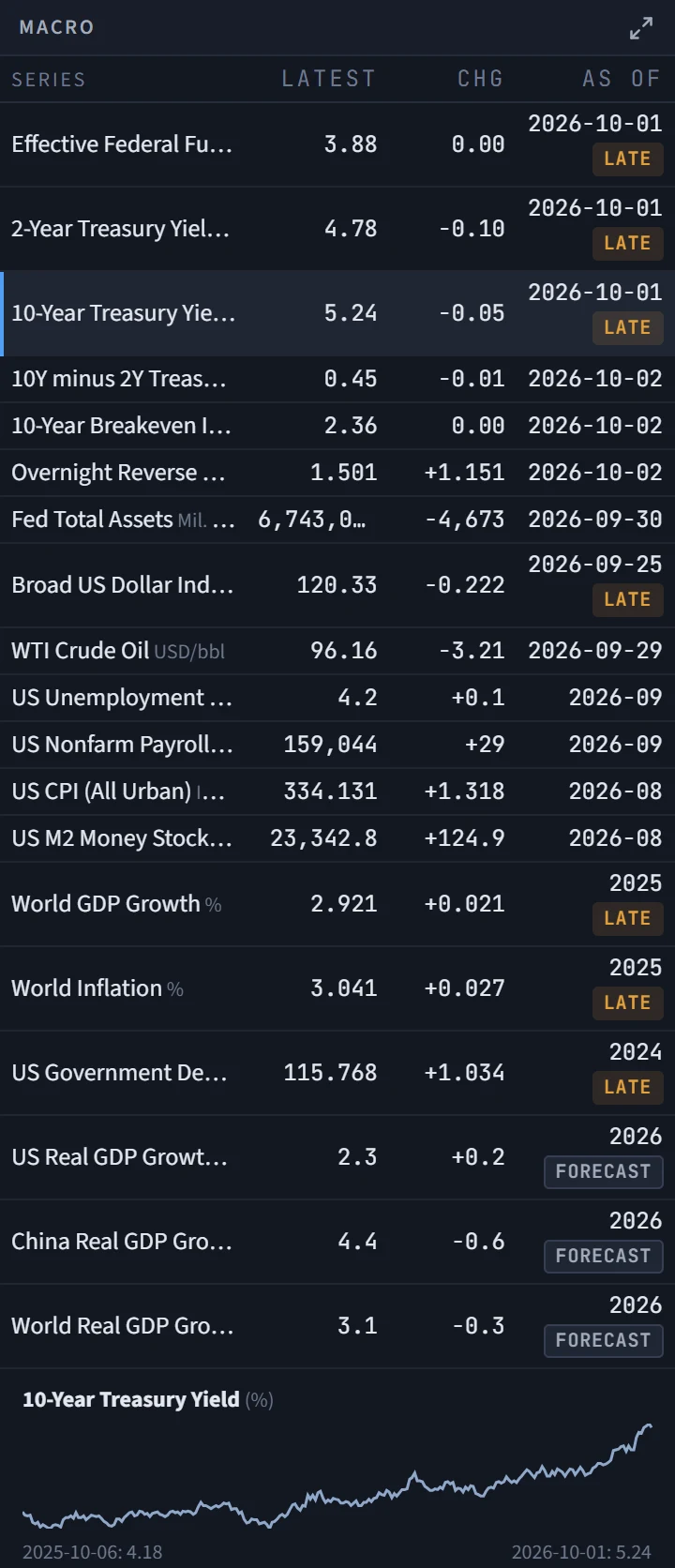
The Macro module puts the macro backdrop next to the chart: interest rates, the dollar, oil, inflation, employment, money supply and growth. It is in the Macro layout, open to everyone.
TapeHawk fetches the figures from their publishers and serves them itself, so your browser never contacts a publisher and the numbers are the publishers' own, shown with the decimals the publisher uses, up to three.
The series
| Source | Series |
|---|---|
| FRED | Effective Federal Funds Rate · 2-Year and 10-Year Treasury Yield · 10Y minus 2Y Treasury Spread · 10-Year Breakeven Inflation · Overnight Reverse Repo · Fed Total Assets · Broad US Dollar Index · WTI Crude Oil · US Unemployment Rate · US Nonfarm Payrolls · US CPI · US M2 Money Stock |
| World Bank | World GDP Growth · World Inflation · US Government Debt (% of GDP) |
| IMF | Real GDP growth projections from the World Economic Outlook for the US, China and the world |
FRED also carries a few well-known series — the VIX volatility index and the major US stock indexes among them — under a third party's copyright. TapeHawk does not show them.
Reading the table
| Column | What it shows |
|---|---|
| Series | The series name, with its unit beside it |
| Latest | The most recent figure the publisher has released |
| Chg | The latest figure minus the one before it, signed, in the series' own unit — a change in a rate is in percentage points, not a percentage of a percentage |
| As of | The period the latest figure is for: a day, or a month (2026-08), or a year (2025) |
Daily series are as recent as the publisher's own delay; monthly series such as CPI and payrolls come out weeks after the month they describe, so their date is well behind today without anything being wrong.
Two tags can follow a date:
- forecast — the figure is the IMF's projection, not a measurement. Projections are never mixed into a series' record: the history below draws only measured figures, and lists the projections apart.
- late — the newest figure is older than this series is normally published. Point at the tag for that sentence. It means the publisher, or the fetch, has fallen behind; the figure itself is the last real one.
Point at a row to see the publisher's attribution for it.
A series' history
Click a row to open its history under the table; click it again to close it. It is a line through every measured observation the module holds, with the first and last values and their dates under it, and the IMF projections listed after it when the series has any. A series with fewer than two observations draws no line — one point is not a trend. The history is fetched when you open the series, not for all nineteen at once.
The release calendar
Under the table, Releases — next 14 days lists the dates in the next 14 days on which FRED publishes a new release of the weekly and monthly series above — the Consumer Price Index, employment, and so on — soonest first, with today's date marked. The daily series are not on it: they change every day.
When a source is behind
Above the table, a note appears for each of the three sources that is not up to date: either that the source has not updated since a date, or that it has not loaded at all. Series from the other sources are unaffected. The Macro pill in the status bar shows the worst of the three: delayed if any is behind, down if any has never loaded.
The table refreshes every 10 minutes and the calendar every 30, while the tab is visible. TapeHawk itself fetches FRED about every six hours and the World Bank and the IMF about once a day, so a refresh shows a new figure only when a publisher has released one.
The notice that FRED's terms require is printed under the table: this product uses the FRED API but is not endorsed or certified by the Federal Reserve Bank of St. Louis.
Feed
Your alerts, the signals fired across every market, and new market recaps on one timeline — how it is ordered, how to filter it, and what it says when the signal engine is down.
News
Crypto headlines from five public news feeds — how to switch between the selected market's and everyone's, what a row shows, and what the module says when an outlet is late.