What is a liquidation in crypto futures?
A liquidation is a leveraged position the exchange closes by force when losses eat through its margin — a forced sell for a long, a forced buy for a short.
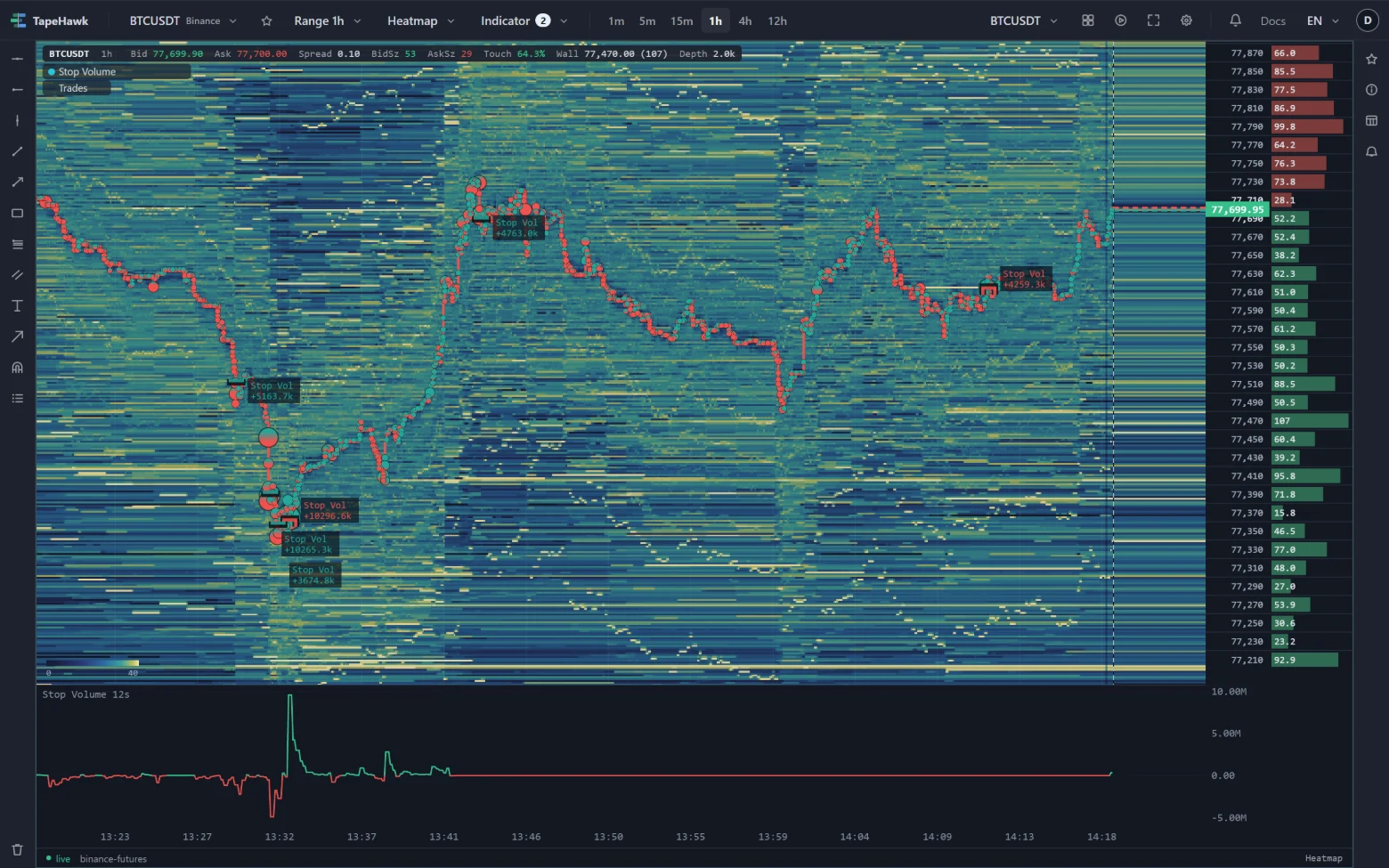
A liquidation is a position the exchange closes by force. When a leveraged trader's losses eat through their margin, the exchange sends a market order to close the position: a long is liquidated by a forced sell, a short by a forced buy. In crypto futures, where leverage is common, liquidations can arrive in cascades — each forced order pushes price into the next trader's liquidation price.
What it looks like on the chart
TapeHawk does not draw the exchanges' liquidation feed. What the chart shows is the trace a cascade leaves in the trades. The heatmap above carries Stop Volume, a line in the band underneath that spikes when size goes through the book in runs across several price levels — the shape stops and liquidations make. Around 13:32, as BTCUSDT fell to its low near 77,380, the band shot up to about 10M and brackets printing +10296.6k and +10265.3k were placed on the heatmap at the low. Later spikes were far smaller: +4763.0k into the 13:41 high, +4259.3k near 14:09.
How traders read it
- A cascade ends when the forced orders run out. A sharp spike followed by a stall is often the bottom or top of a flush, not the start of a trend.
- Crowded positioning is what makes cascades possible: the more leverage stacked on one side, the further a break can run.
- After the cascade, price often retraces part of the move, because the orders that drove it were not decisions to trade at those prices.
On TapeHawk
TapeHawk has no dedicated liquidation indicator: exchanges publish liquidations separately from trades, and the chart does not show that feed. The closest traces are Stop Volume, which weighs runs of size through several levels on the buy side against the sell side, and Stop Runs, which marks chains of aggressive orders pushing the same way. Neither can tell a liquidation from any other aggressive order — they mark the shape, which is the part a trader can act on.