What is absorption in order flow?
Absorption is aggressive buying or selling that trades in size without moving price, because resting orders on the other side soak it up.
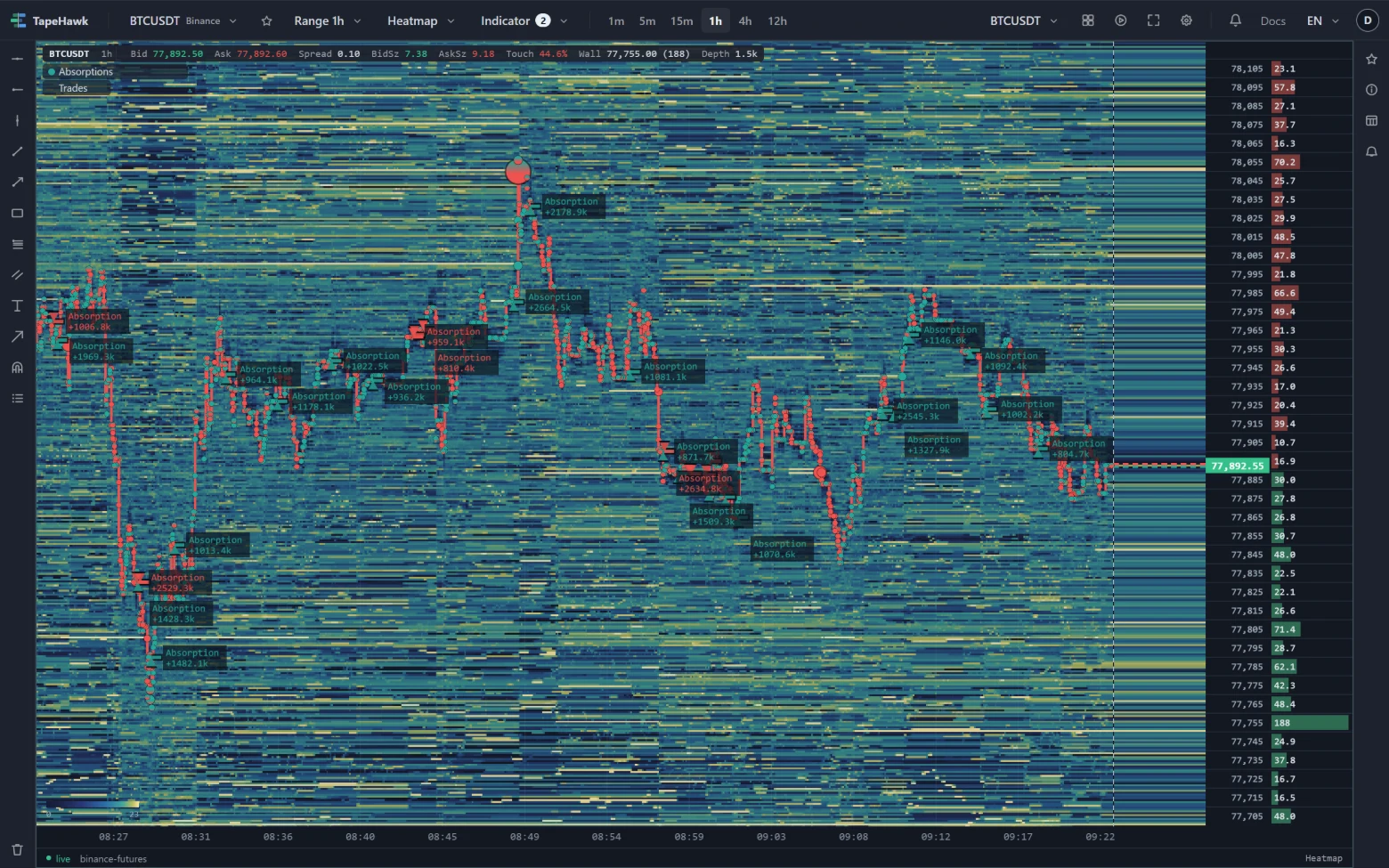
Every trade has an aggressor — a buyer lifting the offer or a seller hitting the bid — and aggression normally moves price. Absorption is the moment it does not. Aggressive orders keep trading, sometimes in large size, yet price stays inside a narrow band, because limit orders resting on the other side of the book take everything that arrives. Someone patient is filling their position against someone in a hurry.
What it looks like on the chart
On the heatmap above, each absorption is a short level on the price trace with a small plate that prints how much traded while price stayed pinned — +2529.3k, +1509.3k. The wedge sits under the level in the buying colour when aggressive buying was soaked up by resting sellers, and above it in the selling colour when aggressive selling was soaked up by resting buyers. Several of them line up along the same prices where the trace turned.
How traders read it
- Buying absorbed near a high means buyers paid up and could not lift price: resting sellers were larger than the demand arriving. Selling absorbed near a low is the mirror image.
- What happens next matters more than the mark. Absorption describes a stand-off. If the absorbing side holds and price turns, that level often becomes a reference traders watch again. If the band breaks, the side that was soaking up size has run out — and the break can be fast, because the resting orders that held price are gone.
- Size is relative. A plate of 1,000k on a quiet market is a different event from the same figure during a news spike. Compare it with the other marks on the same chart.
Absorption is a description of what traded, not a signal on its own. It is most useful next to the heatmap's resting liquidity and the delta of the bars around it.
On TapeHawk
The Absorptions indicator marks these on the heatmap. A mark is placed once the pile-up ends — when the band breaks or the aggression fades — back at the price and moment it first became large enough to count, and buying and selling are judged separately rather than netted against each other.