What is the difference between a market order and a limit order?
A market order trades immediately at the best available price; a limit order waits in the book at a chosen price until someone trades against it.
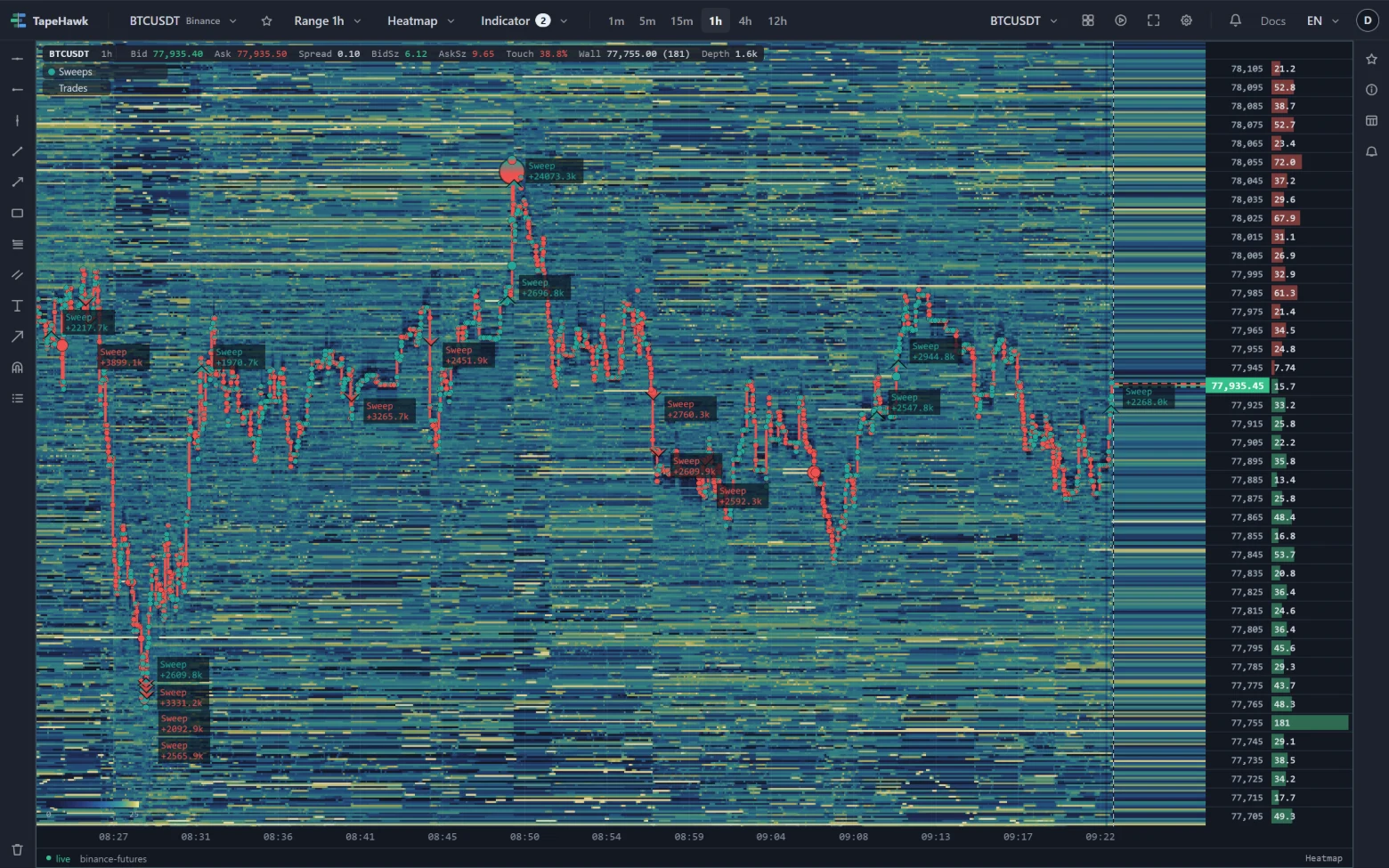
A market order trades immediately at the best price available; a limit order waits in the book at a price you choose until someone trades against it. The market order buys certainty of execution and pays for it with price; the limit order gets its price and risks not being filled. Every trade is one of each: a market order taking a resting limit order. The market order is the aggressor; the limit order is liquidity.
What it looks like on the chart
The heatmap above shows both. The coloured bands are limit orders — size resting at each price, brighter where more waits. The price trace and bubbles are market orders taking them. Each Sweep mark is a single aggressive order that took several price levels in one motion: at 08:49 a buyer swept +24073.3k through the offers, driving BTCUSDT to the top of the hour near 78,060; on the way down, selling sweeps of +3899.1k, +3265.7k and +2760.3k cleared the bids. The ladder on the right shows the limit orders waiting now, the largest a bid of 181 at 77,755.
How traders read it
- Market orders move price, because they consume the liquidity in their way. The larger the market order against the resting size, the further price moves.
- Limit orders absorb. Size resting at a level can stop a move without any trade of its own being aggressive.
- Urgency shows. Someone paying through several levels at once cannot wait; someone resting size at a level can.
- Slippage is what a market order pays beyond the best price when it is larger than the size at the touch.
On TapeHawk
The heatmap draws limit orders as the heat field and the ladder, and market orders as trade bubbles split by aggressor side. Sweeps marks one market order that went through several levels; Big Trades marks single large fills; Absorptions marks market orders being soaked up by resting limit orders without moving price.