What is the bid-ask spread?
The bid-ask spread is the gap between the highest bid and the lowest ask — the cost of trading immediately.
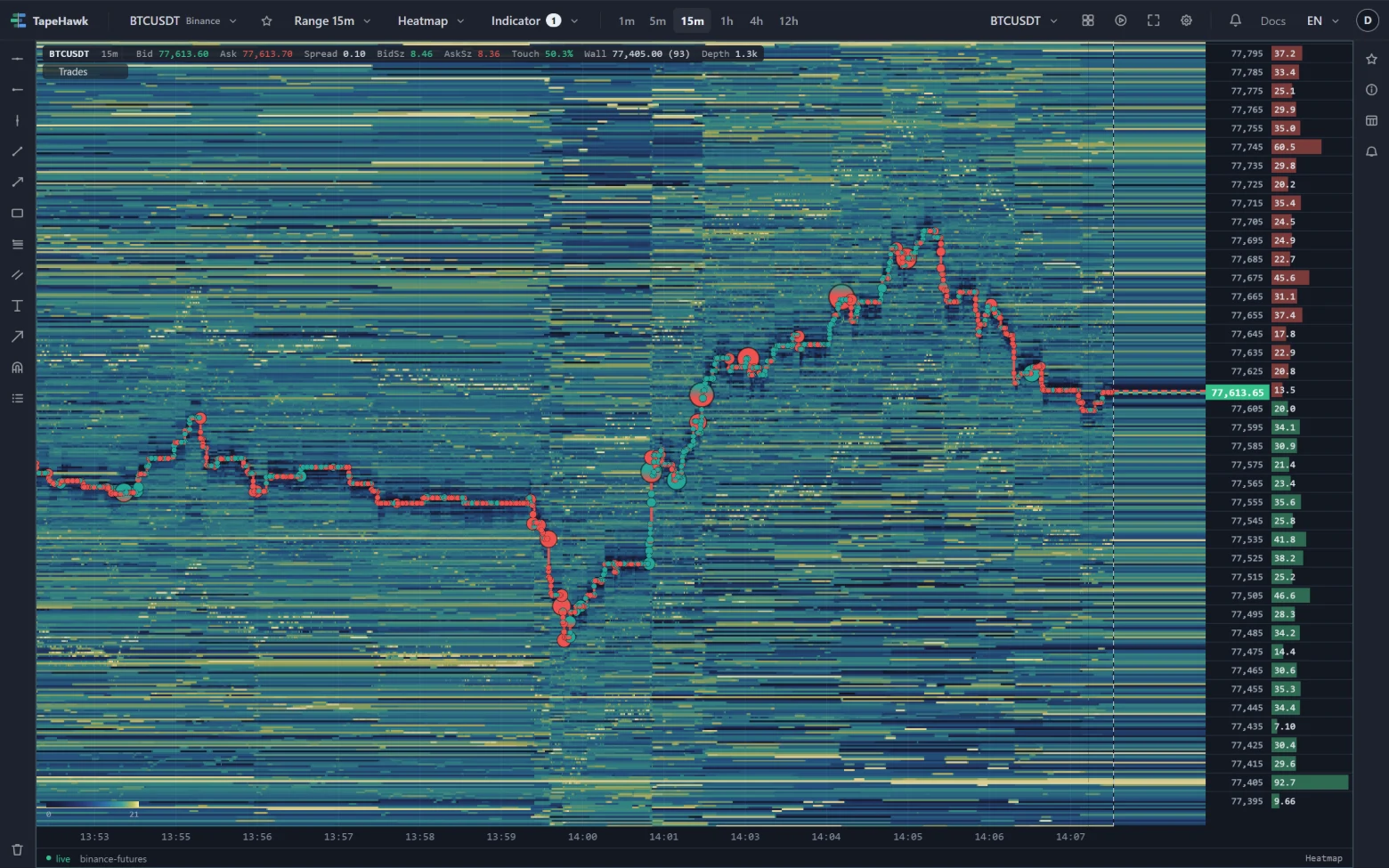
The bid-ask spread is the gap between the highest price anyone is bidding and the lowest price anyone is offering. It is the cost of trading immediately: a market buy pays the ask, a market sell receives the bid, and the spread is what an immediate round trip gives up. In liquid markets it is a single tick; when liquidity thins, it widens.
What it looks like on the chart
The info bar across the top of the 15-minute BTCUSDT heatmap above reads the live book: Bid 77,613.60, Ask 77,613.70, Spread 0.10 — one tick, the smallest step BTCUSDT futures allow. Beside it, BidSz 8.46 and AskSz 8.36 are the sizes at the best bid and ask, and Touch 50.3% says the two sides of the touch are almost exactly balanced. On the ladder at the right, the ask sizes stack upward from the current price in red and the bid sizes downward in green; the spread is the gap between them at the price chip.
How traders read it
- A tight spread means immediate trading is cheap and the market is liquid near price.
- A widening spread is liquidity stepping back — before news, during a fast move, or on a thin symbol — and makes market orders expensive.
- Size at the touch matters as much as the gap: a one-tick spread with little size behind it can still move far on one order.
- Market or limit. Paying the spread buys speed; waiting in the book with a limit order earns it, at the risk of not being filled.
On TapeHawk
The heatmap's info bar shows Bid, Ask and Spread continuously, along with the size at the touch and its balance. The bid and ask traces are drawn over the heat field, so a spread that widened in the past shows as the two lines pulling apart. The ladder beside the heatmap shows the book at each price, on the same grid as the field.