What is spoofing in trading?
Spoofing is placing large orders you do not intend to fill, to suggest demand or supply at a price, and cancelling them before they trade.
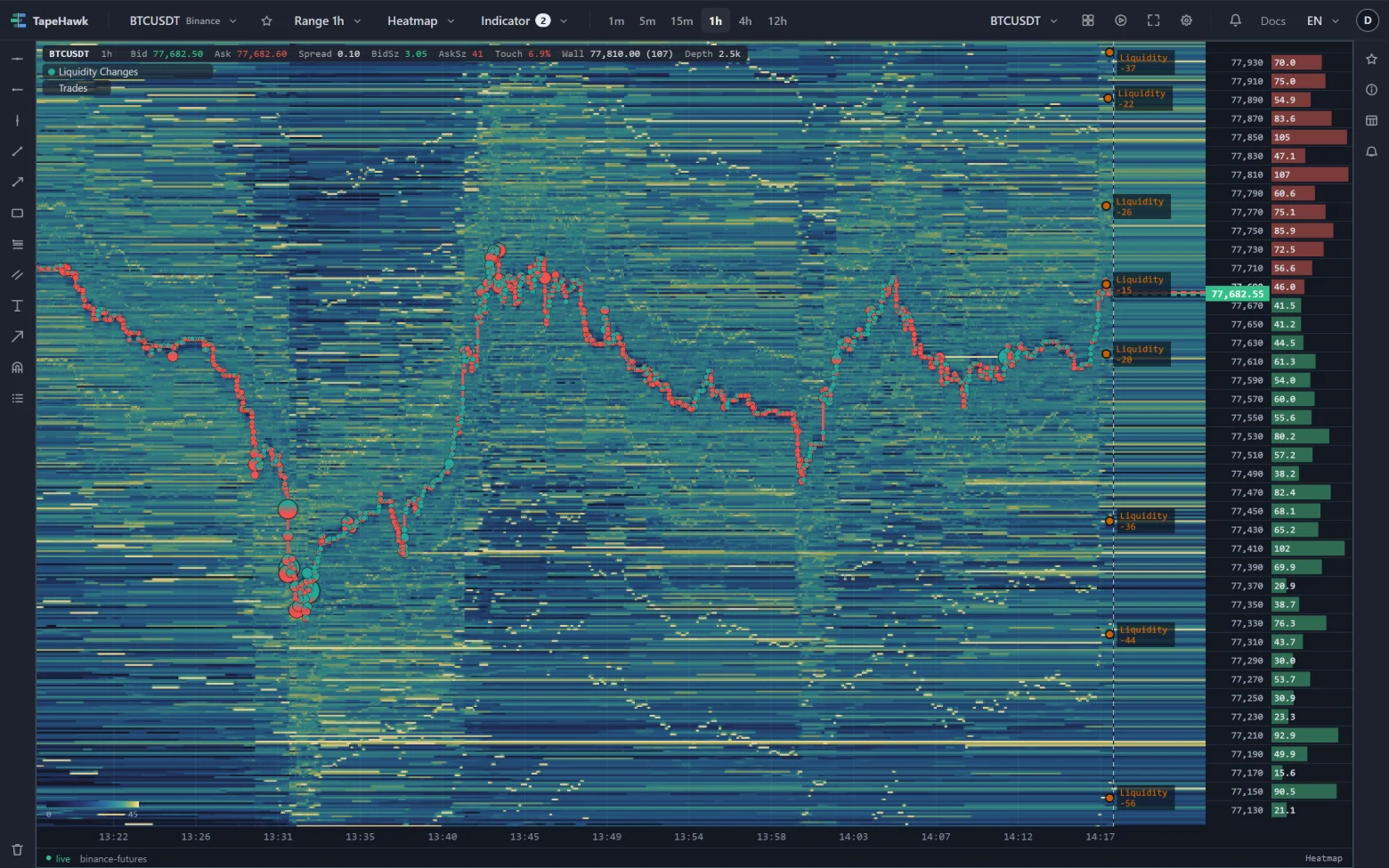
Spoofing is placing large orders you do not intend to fill, to make other traders believe there is real demand or supply at a price, and cancelling them before they trade. A fake wall of bids can draw buyers in and hold price up; pulled at the right moment, it leaves them without the support they were leaning on. In regulated markets it is illegal; in crypto it is common enough that every order-flow trader learns to distrust a wall that has not been tested.
What it looks like on the chart
TapeHawk cannot tell spoofing from an honest change of mind, and does not try — intent is not in the data. What it shows is walls that were withdrawn. On the heatmap above, Liquidity Changes placed a column of circles at the live edge: -37, -22, -26, -15, -20, -36, -44, -56 — large resting orders that left the book without being traded. Some were far from price; one sat near 77,690, just above where price was trading. A wall pulled as price approaches is the behaviour spoofing produces, whatever the reason behind it.
How traders read it
- Untested size is a claim, not a fact. A wall matters when price reaches it and it trades; until then it can disappear.
- Watch the approach. Size that stays as price comes near is committed; size that retreats one step ahead of price, or vanishes, was not.
- Repeated placing and pulling at the same price is the clearest sign someone is managing appearances there.
- Pulled is not traded — the heatmap's trade bubbles show whether size was consumed or cancelled.
On TapeHawk
There is no spoofing indicator. Liquidity Changes marks when the market's largest walls stand and when they are pulled without trading, Book Imbalance shows which side of the nearby book is heavier, and the heatmap shows a band vanishing with no trade bubbles in it. Together they show the behaviour; judging intent is left to you.