What is tape reading?
Tape reading is reading the trades themselves — each execution’s price, size and aggressor side — rather than a summary of them such as a candle.
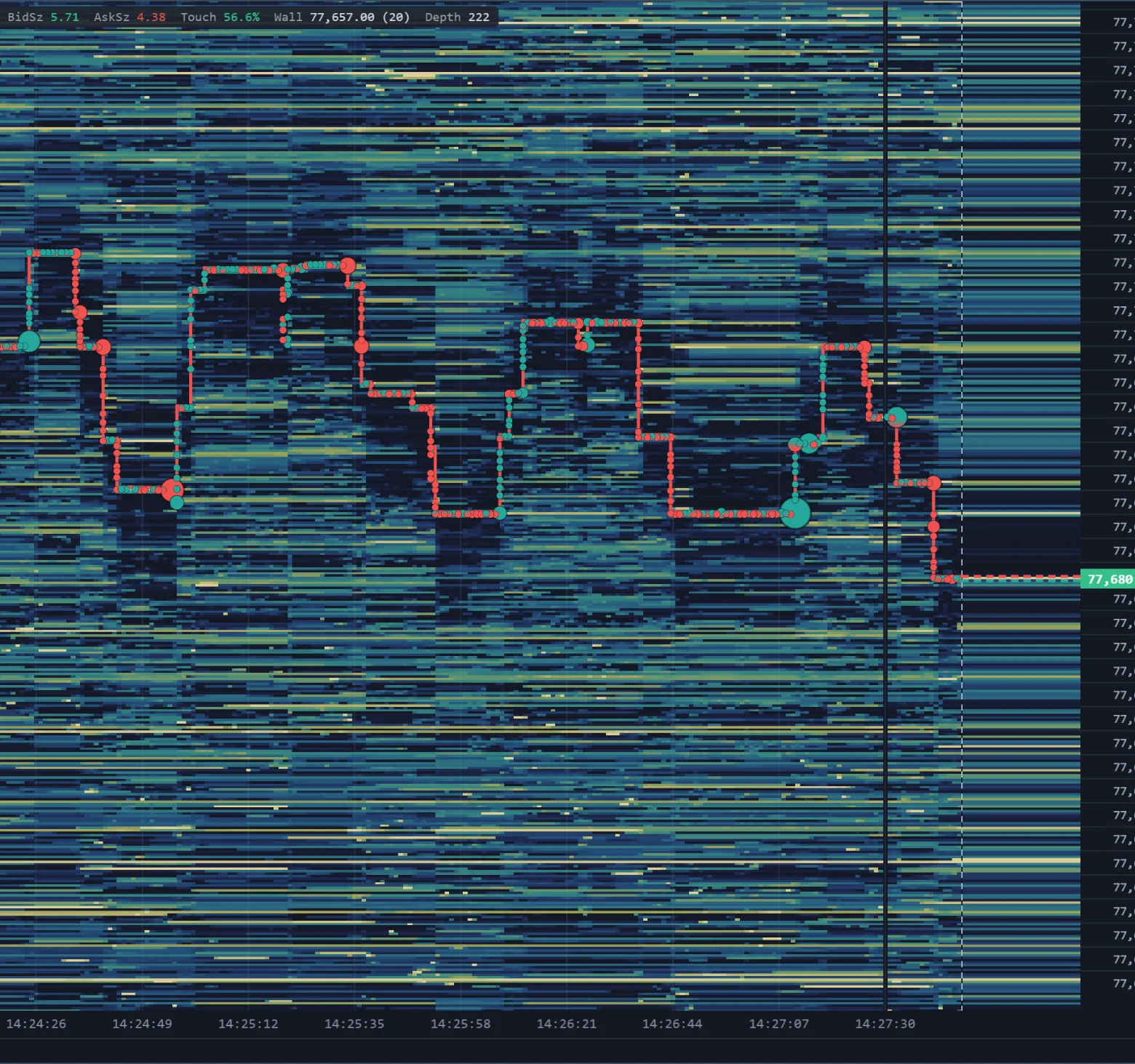
Tape reading is reading the trades themselves — each execution, its price, its size and which side started it — rather than a summary of them such as a candle. The name comes from the ticker tape that printed every trade on a strip of paper. Today the tape is the time-and-sales list, and on an order-flow chart it is drawn: every trade placed at its price and moment, sized by how much traded.
What it looks like on the chart
The close-up above is about three minutes of BTCUSDT tape drawn over the order book. Each bubble is a group of trades at one price and moment, split between the share bought at the ask (teal) and sold at the bid (red), and larger when more traded. The price trace steps between levels as the best bid and offer move. The biggest teal bubble, near 14:27:07, is a burst of buying that lifted price off a level where selling had printed for half a minute; the steps down after 14:27:30 are red-dominated bubbles. The info bar reads BidSz 5.71, AskSz 4.38, Touch 56.6% — the size at the best bid and ask at that moment.
How traders read it
- Pace. Trades arriving faster and larger on one side is urgency. A tape that slows down near a level is a market losing interest.
- Size against the book. A burst of buying into a thick offer that does not lift price is absorption; the same burst through a thin offer is a breakout.
- Who is aggressive. Buying at the ask and selling at the bid are the market orders; the tape tells you which side is crossing the spread.
- Repetition. The same size printing again and again at one price is often one participant working a large order.
On TapeHawk
Every heatmap panel starts with Trades on: the trade bubbles, grouped by what overlaps on screen by default, or by time, volume, price, or price and aggressor. Hovering a bubble reads its total volume, the buy and sell split and its value in dollars. The Min trade setting hides small bubbles, and on long ranges each column keeps only its largest, so shorten the range to read the full tape.