Stop Runs
A mark on the heatmap where several aggressive orders in a row pushed the same way, each starting where the last one stopped — the shape a cascade of stops leaves.
Several aggressive orders in a row, all one direction, each starting where the last one stopped — the shape a cascade of triggered stops leaves on the tape. A sweep is one order; this is a chain of them, which is why it marks moves no single order was big enough to make.
- Heatmap
- any range
- Alerts
- yes
What it shows
A chevron with a bar on the heatmap wherever a chain of aggressive orders went the same way: one order pushes price, the next starts where it stopped and pushes on, and so on, with only short pauses between them. That is the shape a cascade of triggered stop orders leaves on the tape — each stop's market order runs price into the next.
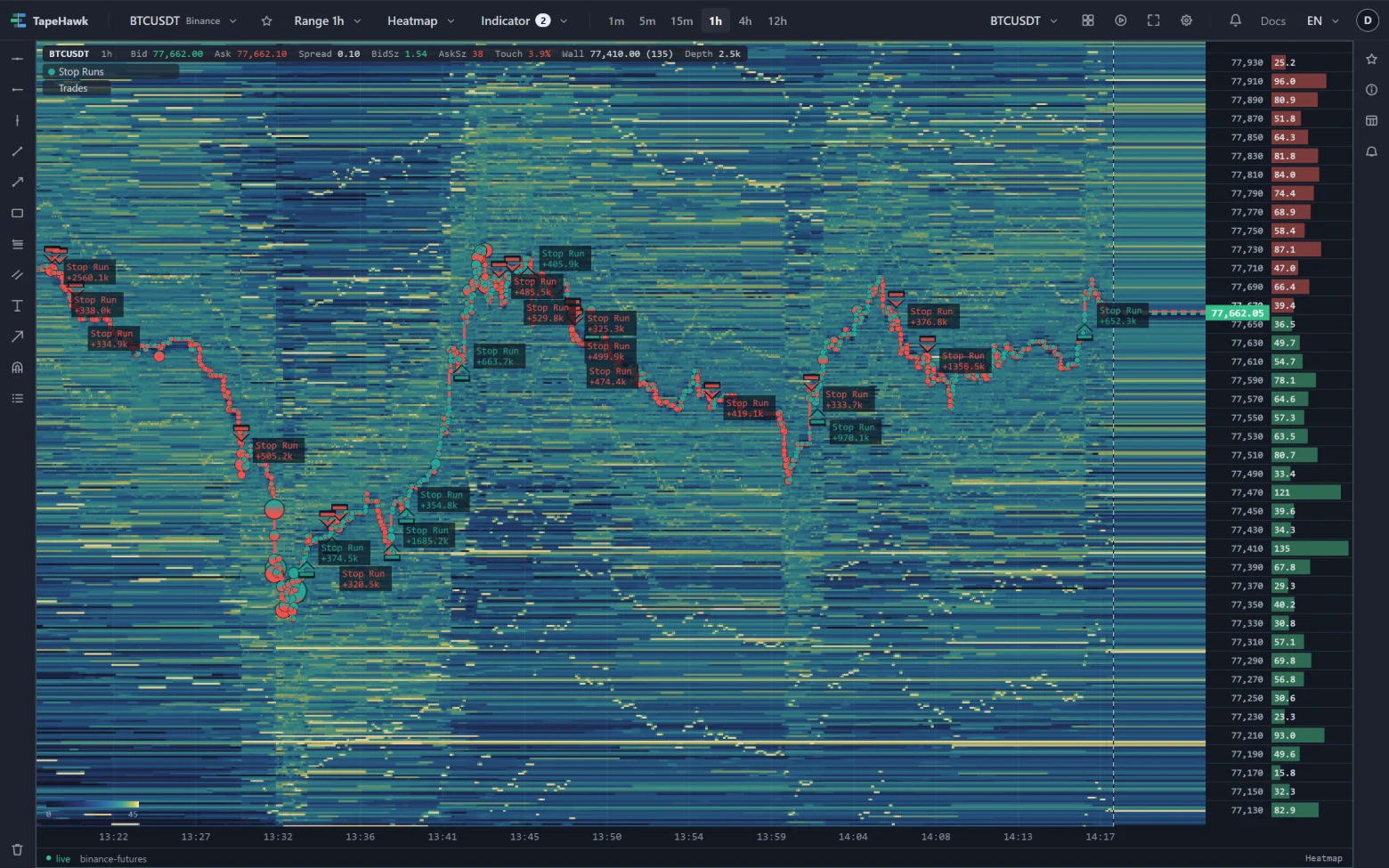
Where a sweep is one large order, a stop run is several ordinary ones added together, which is why it catches moves no single order was big enough to make.
The mark is placed at the moment the chain began and at the price it had reached when it qualified, and it fires once per chain, as soon as the chain is long and large enough — not again while it keeps running. It points up, from below, in the buying colour for a chain that bought; down, from above, in the selling colour for one that sold. The plate prints the chain's total size in the quote currency. Figures, tooltip, held marks and history work as for every mark on the heatmap.
How to read it
- A run up through a level where shorts would keep their stops is a squeeze; a run down under a level where longs keep theirs is a flush. The heatmap shows which level it went through.
- After the run, forced orders are spent. Price that stalls just beyond the run is often the move running out of fuel; price that keeps going found real buyers or sellers behind the stops.
- Several runs stacked in one direction describe a market liquidating one side step by step.
Parameters
| Setting | Control | What it does |
|---|---|---|
| Chain volume (M) | Number | Range and default are set by TapeHawk; the settings dialog shows them. |
| Orders in the chain | Number | Range and default are set by TapeHawk; the settings dialog shows them. |
| Chain window (ms) | Number | Range and default are set by TapeHawk; the settings dialog shows them. |
| Gap (ms) | Number | Range and default are set by TapeHawk; the settings dialog shows them. |
| Chain volume max (M) | Number | Range and default are set by TapeHawk; the settings dialog shows them. |
| Hold back marks the flow contradicts | On / off | The default is set by TapeHawk. |
| Hide held marks | On / off | A held mark is one this indicator decided not to assert: it is drawn as an outline with no label and sends no alert. The outline is there so you can judge the filter rather than trust it — you see the cascades it held back. Turn this on once you are satisfied and the outlines go; nothing is deleted, and turning it off puts every one of them back in the same frame. |
| Max marks / minute | Number | At most this many marks in any one minute, so a burst stays readable — and the same number is the ceiling on how often an alert rule on this signal may reach you. A rule takes this default and keeps it: turning the knob on a panel changes the drawing only, because this is a display setting and a rule inherits only what changes the numbers. 1–30 · default 5 |
| Buying colour | Colour | |
| Selling colour | Colour |
Orders in the chain is how many orders in a row make a chain — the setting that separates this signal from Sweeps: too few, and ordinary pairs of orders qualify. Chain volume (M) is how much the whole chain must carry, in millions of the quote currency; it is absolute, its default is set for BTCUSDT, and Chain volume max (M) can optionally ignore chains above a size; left at its lowest it ignores none.
Gap (ms) is how long a pause ends one order, as on Sweeps. Chain window (ms) is how long a pause between two orders may be for them to stay one chain.
Hold back marks the flow contradicts holds back a chain when the recent order flow leans against the direction it pushed; see held marks.
Alerts
The Alert tab has one signal, run. Switch it on and TapeHawk tells you when a stop run
marks on this symbol, with its size, price and side. The alert uses the settings on the Parameters tab at the moment you
switch it on; if you change them later, the tab offers to bring the alert along. Held marks send no alert, and an alert
reaches you at most as often as the default Max marks / minute allows. Alerts need a confirmed
account; Signal alerts covers the rest.
Limitations
- The exchange does not label stop orders, and TapeHawk does not claim to know them: what this marks is many orders in a row in one direction, the shape a stop cascade takes.
- One chain gives one mark, placed at its start; a long cascade that keeps going after it qualifies adds nothing more.
- It is drawn on heatmap panels only, so only on symbols TapeHawk records, and it reaches back 24 hours.
- The size is an absolute amount, so one setting does not fit every symbol.
Sweeps
A mark on the heatmap where one aggressive order pushed a large amount of size through several price levels in a single motion.
Book Imbalance
Which side of the resting order book near price is heavier, as a smoothed line under the heatmap, with a mark when the tilt passes a trigger and when it flips sides.